My Inner Skeptic and Cynic on Recent US commentary on Turkey

The US foreign policy community has been making quite a few waves on Turkey lately. Barely a month ago, two former US ambassadors to Turkey wrote a scathing op-ed in Washington Post criticizing Erdogan and the AKP in its civil war with former allies in the Gulen movement. Yesterday, a who’s-who of the US foreign policy community wrote an open letter to Barack Obama claiming Erdogan is “subverting Turkey’s political institutions and values and endangering the U.S.-Turkey relationship.”

It’s certainly a good thing that influential policy leaders are aware of the real risk that Turkey’s fragile democracy could erode into an authoritarian one-party state. But the Skeptic in me feels these interventions lack a crucial component. Dani Rodrik voiced this in what I think is probably the best paragraph I read on Turkey this week:

We cannot look at all this and focus only on what Erdogan is doing without at least acknowledging that the Gulenists also bear considerable responsibility for bringing the country to its current crisis. The idea that there was something like the rule of law or Turkey was democratizing before Erdogan began to tighten the screws on the Gulen movement is dangerous nonsense. Those who call on Erdogan to respect democracy and the rule of law should be calling on the Gulen movement to do the same. Otherwise, they end up taking sides in a war in which neither side looks pretty.

It’s hard to keep a straight face reading some of the above linked interventions. One wonders where these concern were during the height of the Ergenekon, Sledgehammer trials, and KCK trials, which are only the most recent of Turkey’s long list of tainted political trials. I don’t remember seeing any concerns voiced after the Roboski massacre, when fighter jets bombed 40 (mostly-teenager) Kurdish villagers crossing the Iraq.

In regards to this, my inner Cynic is quite informative. In addition to noting that Kurdish villagers do not give a lot of political donations to US politicians, moreover the the apparent shift in many US policymakers’ views on Turkey may not be about its quality of democracy at all (perhaps it should, though).

Instead, as Michael Koplow explains in a recent Foreign Affairs article, the US has been getting increasingly annoyed with Turkey’s government for a host of other (not necessarily related to the quality of democracy) events. You should read the whole article but among a few key points that likely underlie the likely end of the US-Turkey “model relationship” are: Continue reading

Here’s to Tunisia’s new constitution, let’s hope it matters

Tunisia has a new constitution, and it’s relatively liberal. It’s a much-needed sign of progress in a region that hasn’t seen much of it lately, and we’re all naturally very excited.

Some of us are perhaps more excited than others. Here’s Mustafa Akyol in The New York Times:

In 2011, protests led to the ouster of Tunisia’s longtime dictator, Zine el-Abidine Ben Ali. The spirit of revolution soon spread to other Arab countries, albeit with less-impressive results. Libya suffered from bloody internal turmoil; Egypt reverted to brutal military rule; Syria continues to be ravaged by civil war. In Tunisia, however, the nascent democratic process has not been derailed. The country’s new Constitution — the most liberal and democratic charter the Muslim Middle East has ever seen — remains the Arab Spring’s crowning achievement to date.

Ratified on Jan. 26, the Constitution is a strikingly “We the people” document in a region where “Me the state” has long been the norm. It protects civil liberties, establishes a separation of powers, and guarantees women parity in political bodies. Though it declares Islam the country’s official religion and refers generally to Tunisia’s identity as an Islamic state, the Constitution protects religious freedom for all.

Civil liberties, separation of powers, gender equality, and religious freedom for all… Now, I understand how the author badly wants to swim in this wonderful liberal-democracy-for-all-soup. After all, I can only imagine how disappointing it must be to have expected this to occur in Turkey and instead getting penguins, porn lobbies, and pepper spray.

Also, I’m not completely convinced by describing Tunisia’s constitutions as “the most liberal and democratic charter the Muslim Middle East has ever seen”. I’d like to see a real comparison between Turkey’s 1960 constitution and this one… Continue reading

Radical Political Islam and the Empowerment of the Poor and Pious

I have a paper coming out in Econometrica this month (ungated version here) on how local Islamist mayors increased female participation in education in Turkey during the 1990s. The main contribution of the article is that it uses a method called the Regression Discontinuity Design (RDD) which allows identifying an estimate of the causal effect of having Islamist political control.

A focus on causality is important as the reason why Islamist-controlled constituencies have poor women’s rights may come from voter-specific characteristics, like preferences for political Islam, as much as the effect of the Islamist politician itself. If politicians have little power to influence policy other than adopting the policy position of a representative (often the median) voter, then (Islamic) party identity doesn’t matter for policy, only voter preferences do. Resulting policies may be detrimental to development, but is then the result of voter preferences, not politicians. If for some reason, elected politicians can influence policy away from the representative voter to their own preferred position, then politician identity will matter for policy. In this case, unwanted policies may be as much the fault of the politician (see this paper for more through discussion). Continue reading

Remembering Gezi

2013-06-04 11.34.52

I meet “Zeki” in a bar in central Beyoğlu. He’s around thirty. His eyes and face are all red, and when he speaks he sounds like one of those in-movie mob bosses on life support. He tells me all this is due to his participation in four nights of riots around Taksim Square and in the Beşiktaş quarters, his visible medical symptoms the consequences of breathing in and just being around pepper- and tear gas. Despite this, he tells me, he only needed to visit the hospital once, which happened to be the night before I ran into him.

During a tense clash with the police  in Beşiktaş the night before, a female friend of his faints,  as much out of exhaustion as the tear gas. Without thinking, Zeki picks her up and starts to walk away from the police and the fighting. At that point, he his by a plastic bullet in his rear end. The reason for this brief hospitalization is thus “plastic bullet in the butt.” It could be worse, of course, but at that moment in the bar, it couldn’t be more funny.

After we stop laughing at this, he tells me more about himself. Zekis has an M.A. from UC San Diego, an uncle in Reykjavik, and works as a stock broker in Istanbul’s financial district. In the last election, he voted for Erdoğan and the AK party. He’s thus not your average protester. And Gezi isn’t your average protests.

This is from my notes, written while visiting Istanbul during the Gezi protests last summer. The reason why I was looking through them again was this week’s start of the court case against the police officers allegedly behind the death of Ali Ismail Korkmaz. Seeing the picture of Ali Ismail’s mother sitting with his picture in her lap, it hit me that it’s been more than half a year since the Gezi protests shook Turkey. Since then any illusion of political instability in one of the US (and Sweden’s) key allies in the region has been shattered. Continue reading

“Education reforms divide Turkey”

A recent article in the FT writes how the recent 4+4+4 education reform is dividing the nation:

Preparing glasses of tea with leathery hands, Yasar says he has learnt to value education. He may run a hot drinks stall in Istanbul, but of his four daughters one is an engineer, another a teacher, the third is a lawyer and the last is still studying.

His family is a relative rarity in Turkey, a country where, according to the United Nations, only 24 per cent of women have jobs or are seeking them – half the level of the European Union average and less than in Algeria and Qatar.

Education makes a particular difference here. While about 10 per cent of Turkish women are illiterate, their well-educated counterparts have prospects that compare well with elsewhere, holding about a third of senior management positions in Turkish business.

This is the backdrop to a battle over proposed school reform that exposes the century-old faultline in Turkish society between religious conservatives and secularists, pitting leading industrialists against the government.

Supporters say the education reforms will help erase the legacy of Turkey’s undemocratic past and make education more attractive to conservative, religious families. Critics allege the changes could encourage some households to take their daughters out of school.

“There is a concern that the number of child brides and child labourers will increase,” says Guler Sabanci, the head of Sabanci Group, one of Turkey’s biggest conglomerates.

Stallholder Yasar shares these fears. “I am against these reforms; they will increase illiteracy,” he says.

Merve, a student who like most Turkish women covers her head, disagrees: “It will make it easier for girls with headscarves to go to school.”

At issue are government plans to substitute the current eight uninterrupted years of primary school education with four years at infants school followed by four at middle school. The change will allow children aged 10-14 to attend specialist religious schools, known as imam hatip schools.

The reforms are the brainchild of Recep Tayyip Erdogan, Turkey’s popular and powerful prime minister. Mr Erdogan emphasises the “non-democratic” origins of the present education system, introduced in 1997 after the military ejected an Islamist-led government and closed the imam hatip middle schools by decreeing that children should stay at infants school for eight years. The secular rulers of the time never disguised that they wanted to push aside religious schools for younger children, although imam hatip schools continued for those aged 14 or above.

“We are ending oppression,” Mr Erdogan told his members of parliament this week, after his party hurried the bill along amid fisticuffs with opposition MPs.

But the 1997 shift had other effects as well. According to a study by Istanbul’s Koc University and Tusiad, the Turkish business federation, the proportion of girls married at the age of 16 fell 46 per cent in the succeeding years.

Some business leaders voice concerns that the latest change could reverse this trend.

Umit Boyner, Tusiad’s chairwoman, has suggested the proposed new system of separate infants and middle schools could also encourage parents to keep their girls at home after the first four years. Tusiad adds that most developed countries do not have specialist education before 16 and that a broad education is important for a flexible labour force.

Mr Erdogan, who has spoken of his ambitions to raise a religious generation, has told Tusiad to mind its own business. The package of school reforms also extends the period of compulsory education from eight to 12 years, which supporters say will improve educational standards and combat illiteracy.

Nursuna Memecan, a ruling party MP, emphasises that while the origins of imam hatip schools was to train the future Muslim clergy, the schools teach the full curriculum.

Imam hatips have provided education to many boys and girls who otherwise would not be in the educational system [because their conservative parents would keep them away],” Ms Memecan says.

The government has backtracked on measures allowing home education for children aged 10 and above – a provision that had raised concerns about girls dropping out. But educationalists protest that they were not consulted on the reform, even as Mr Erdogan underlines his determination to push it through.

Education in Turkey is about more than teaching skills [Graphic evidence]

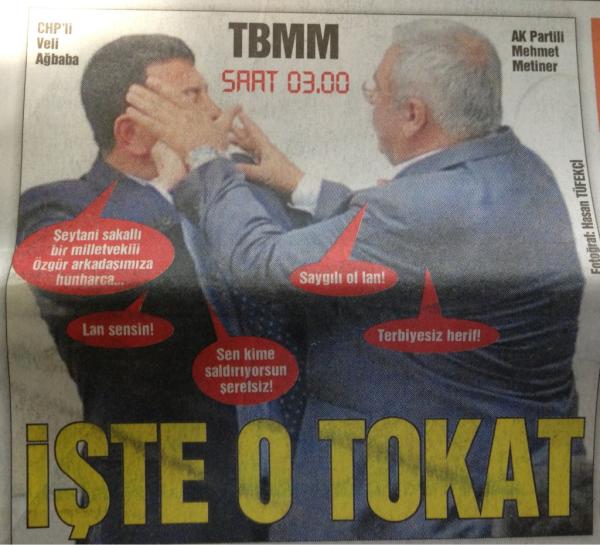
Instead of writing in our recent paper that education was always about more than just teaching and learning, we should have just attached this picture, from yesterday’s parliamentary debate on the new education reform in Turkey.

Note to reader: It should be noted that not all sessions on education policy include ‘choking’. Sometimes they occur in a professional fashion where no MPs are hurt in the policy’s making. The welfare of certain students affected by such past policies, however, is another matter, but this doesn’t always make the frontpages of mainstream newspapers in Turkey.

HT: @zeynep_erdim and @aylajean

New paper on education, religion, and empowerment in Turkey

Here is the abstract from my new paper with Selim Gulesci:

We assess the religious and social impacts of female schooling in Turkey using a law change in compulsory schooling. The law, implemented in 1998, bound individuals born after a specific date to 8 years of schooling while those born earlier could drop out after 5 years. This allows the implementation of a Regression Discontinuity Design and the estimation of meaningful causal estimates of schooling. Using a dataset of married Turkish women in 2008, we find large reducing effects of a year of schooling on expressions of religiosity, such as the habit of wearing a headscarf, attending Qur’anic courses, and regular prayer. Parallel to these, we also document a partial empowerment effect, whereby women are more likely to make marriage decisions themselves, less likely to marry under the legal age, and to experience better household characteristics. A noteworthy non-result is the lack of clear effects on female labor force participation. On one hand, we show that returns to schooling in terms of women’s status and living conditions may be substantial even when labor-related returns are not. In particular, our results are consistent with education allowing social mobility out of religiously conservative environments; with women more independently choosing richer, and more educated husbands outside the family circle. On the other hand, however, we also document the absence of commensurate impacts for the country’s large ethnolinguistic minorities. An evaluation of the education reform thus needs to weigh its average empowering effects against increased inequality across ethnolinguistic groups.