In last post I questioned some of the Swedish government’s fascination with Turkey’s recent democratic reforms, which although carry the label of democratic reforms, do not address the fundamental problems. This post is about the government’s infatuation with the Turkey’s economic success.
In addition to last year’s Turkish state visits to Sweden (see here and here), a number of more focused trade-relation visits have occurred (see here, for an example). It was likely no coincidence that, sitting in Stockholm University Aula Magna during the inauguration ceremony for the new Swedish institute for Turkish studies (SUITS) last year, that the ratio of businessmen-to- academics seemed rather high.
One can understand the lure of Turkey’s economy for Swedish firms – the country has 74 million inhabitants, a relatively young population, is the 17th largest country in terms of IMF-measured PPP GDP. Moreover, the government’s expansion in infrastructure and technology sectors coupled with a burgeoning middle class, the possibility of a resolution to the decades-long conflict in the east, as well as a possible stepping stone into the Middle East, all add to the pull.
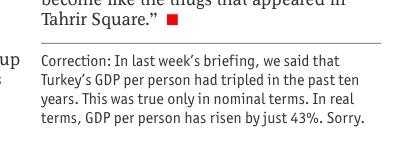
A ubiquitous talking-point in Turkish foreign policy is the claim that, under AKP rule, the country’s GDP has tripled. This, however, is a misleading number as it relies on valuing US dollars of Turkey’s GDP at current prices, thus pooling both inflation of the dollar and the real appreciation of the Turkish lira on top of real growth. In real terms, Turkish GDP at constant prices grew by 64 percent between 2002-2012, and GDP per capita grew by 43 percent. A decent growth rate, but nowhere near the miraculous. Continue reading →
 Erik Meyersson