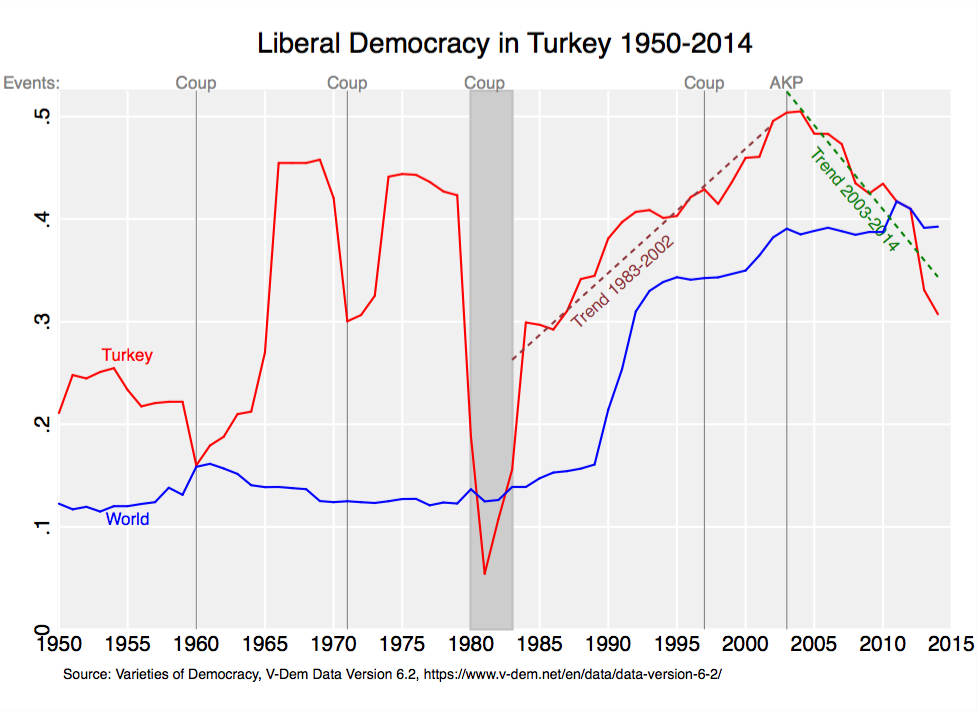
Earlier this year, the University of Gothenburg’s V-Dem institute released a new database on democracy. As it turns out, this database yields some new insights on the timing of Turkey’s democratic erosion, a topic I’ve previously covered (here, here, here, here, here, and here).
Here’s how Staffan Lindberg, the director of the V-Dem Institute, described the database to the Washington Post:
“Varieties of Democracy (V-Dem) represents a novel approach to measuring democracy. It is based on collaboration among leading scholars across the world and has two institutional homes: the V-Dem Institute at the University of Gothenburg in Sweden, which also functions as the operational headquarters for the project’s many parts, and the University of Notre Dame in the United States. V-Dem differs from previous datasets by distinguishing among different principles of democracy (as discussed) and offering about 350 unique democracy indicators, 34 indices of various aspects of democracy such as freedom of association, and five main democracy indices for Electoral, Liberal, Participatory, Deliberative, and Egalitarian democracy. These all cover 173 countries, measured annually from 1900 to 2012.”
Frankly, as a political economist (and all-out data nerd, for that matter) I have trouble expressing how exciting this is.
Of particular interest is the measure of liberal democracy, a topic of significant focus both globally (here, here) and specifically for Turkey (see here and here), but I’ll show graphs for the other main components of the V-Dem data as well.
Readers of this blog and my other work will be familiar with my skepticism of the prevailing narrative of the timing of and character of Turkey’s democratic erosion. As I wrote in a recent blog post:
“Given recent crackdowns on freedoms in Turkey, it might be useful with some perspective. Some in the media still seem to be pushing the talking point that Turkey’s “true oppression” began in 2013 after a corruption scandal, contrasting this period with that when AKP was a “beacon of light”, when Turkey was a “vibrant democracy”, and when “Erdoğan’s Turkey” was on the “right path.” Accepting this narrative is a convenient exit for analysts who have overestimated the degree to which Turkey’s democracy was improving during the last decade.”
As it turns out, the data recently provided by V-Dem has something to say about this. Continue reading →
 Erik Meyersson